Sunday, 27 May 2012

Forth Rail Bridge Memorial


                                                                                                                                                                                              On Friday 18th May 2012,Alex Salmond the First Minister of Scotland unveiled two memorials to the men killed in the construction of the Forth Rail Bridge. Located at either end of the bridge in North and South Queensferry,the cast bronze memorials bear the names,ages and occupations of 73 men,known as 'briggers'. Around the base are the the words:

  To the Briggers,past and present who built,restored and continue to maintain this iconic structure.

This event is the culmination of a ten year restoration project by Network Rail and Balfour Beattie and finally sees the bridge for the first time in as many years without scaffolding. Local members of the Queensferry History Group and enthusiasts over the last seven years have trawled through records in archives and newspapers to identify the fatalities.
Construction spanned 1883-1890 and used over 6.5million rivets in the 1.5mile long bridge. This week sees the positioning of the steel caissons for the foundations of the third Forth Bridge due to open in 2016. There are plans to raise funds for similar memorials to commemorate those killed in the Tay Bridge disaster of 1879.


Forth Rail Bridge from South Queensferry

The list of names can be viewed at :


Saturday, 12 May 2012

Surname Saturday Crichton

Surname Saturday

Crichton


A distinctive Scottish surname of numerous spellings: Creighton,Crighton,Crichten, which is of territorial origin from the barony of Crichton in Midlothian. The earliest recorded witnessed a charter by King David c.1128

Crichton Castle
Heavily involved in Scottish politics during the 14th and 15th centuries, it was Sir William Crichton who brought the family to eminence.He held in succession the offices of Chamberlain, Master of the Household and Governor of Edinburgh Castle and as Chancellor of Scotland, plotted the downfall of the rival House of Douglas. Members of the family acquired land through marriage in other areas of Scotland.
 Sanquhar in Nithsdale,Dumfriesshire was home to the Crichtons remembered in the ballad The Lads of Wamphray  for their feud with the Johnstones of Annandale.The title Lord Crichton of Sanquhar (1488) in later generations was elevated when 9th Lord Crichton was created Earl of Dumfries (1633) . This title was inherited by the Crichton-Stuarts,Marquesses of Bute,whose heir apparent retains the title Earl of Dumfries. The current 7th Marquess was known as Johnny Dumfries when driving in F1 motor racing.

The Crichton,Viscounts of Frendraught in Banffshire acquired this land through marriage with the Dunbars. They were supporters of Montrose and Jacobite sympathisers eventually exiled to France.
Another branch  settled in Ireland shortly after the Plantation of Ulster.Taking land about 1613 in Co.Fermanagh they became Earls of Erne and still live at Crum Castle.Accounts differ as to their origins.Some say they descend from the Crichton,Viscounts of Frendraught and others,from the Crichton,Lairds of Brunston near Edinburgh. In 1872 the Earl of Erne changed the spelling from Creighton to Crichton.

The current chief of clan Crichton,David Maitland Makgill Crichton of that Ilk lives at Monzie Castle in Perthshire and is a Member of the Standing Council of Scottish Chiefs.Their tartan is of recent origin, based on the colours of the family arms and the Makgill tartan.It was  registered in 2009 for the last Clan Gathering in Edinburgh.

The Crichton name has disappeared from the roll of peerage and their once mighty castles are now no more. Crichton castle in the care of Historic Scotland is a magnificent ruin and testimony of their previous power,Sanquar castle is a much reduced ruin and  of Frendraught tower not a vestige remains.


Crichton Castle
Useful links:

www.clancrichton.org
www.clan-crichton.com
https://www.facebook.com/clancrichton

Erne Papers
http://www.proni.gov.uk/introduction_erne_d1939.pdf


Saturday, 28 April 2012

Surname Saturday - VIPONT / VIPOND

Every now and then I come across an uncommon surname and I wonder about it's origins.Then later,when searching indexes or wandering around a graveyard, the surname I thought so rare jumps out at me from the most unexpected places.

Recently I noticed the surname Vipont while visiting the Borders archive in Hawick. Those who follow sport in Scotland will be familiar with the television  broadcaster and 'Adventure Show' host, Dougie Vipond and  those from further afield from his days as the drummer in the pop band 'Deacon Blue'.


Only half a dozen Scottish surnames start with the letter  'V',so where did this unusual name originate and is it Scottish?

Vipont appears to derive from several places in Normandy called Vieupont or Vieuxpont; 'old bridge' and the Norman family that came to Britain hailed from Vipont near Lisieux. The Scottish Viponts are descended from William de Ueupunt who was granted land in Westmorland by William the Lion,c1165-77.Scotland and England were continually in dispute over Cumberland and Westmorland until the Border was legally resolved by the Treaty of York in 1237.

Though not uncommon for nobles from either country to own land in both Scotland and England the paths taken by the Vipont families diverged. The Viponts in England granted land during the Scots short occupancy, became Lords of Appleby and High Sheriffs of Westmorland.Their Scottish cousins held land in Carriden,West Lothian and Loch Leven,Fife. During the 14th century the Scottish Viponts witnessed several charters and in 1296 rendered homage to Edward 1 of England. The sixth baron,Sir William de Vepont was described by the poet Barbour as one of 'two worthy knights' killed on the Scottish side at Bannockburn in 1314. His death led to the families decline. Their Carriden estates passed through the female line to the Cockburn family, progenitors of the Berwickshire family,Cockburn of that ilk.

Never a surname of large numbers, the distribution of Viponts in the 1881 census as expected is found predominantly in north west England. Black commented in 1946 that 'the surname is now almost extinct in Scotland.'
This case illustrates;what is a Scottish surname? Of Norman origin and possibly Norse prior to that,Vipont was carried to both Scotland and England before the creation of the Border as we know it. Both branches went their separate ways, one to flourish, the other decline.With so few left bearing the surname they are surely a candidate for a one name study. You may even be related to a former pop star.

Black,G (1946) The Surnames of Scotland :The New York Public Library.
Thomas,D (2012) Vipond History [online] Available at: www.vieuxpont.co.uk [accessed 28/04/2012].
Great Britain Family Names. Vipond [online] Available at:  http://gbnames.publicprofiler.org/Map.aspx?name=VIPOND&year=1881&altyear=1998&country=GB&type=name [accessed 28/04/12]
The Very Best of Deacon Blue http://en.wikipedia.org/wiki/The_Very_Best_of_Deacon_Blue [accessed 28/04/012].

Monday, 31 October 2011

Memorials to Scotland's Last Witches


Over the last two years on Hallowe'en I have posted blogs about execution sites of Scottish witches.* This year I conclude with the memorials to the last two witches to be burnt in Scotland. One from the Lowlands and the other from the Highlands.

The Presbytery of Dunbar in East Lothian was responsible for burning 100+ witches including 6 women and 2 men from the Parish of Spott.In 1698 the trial of Marion Lillie,known as the Rigwoody Witch (old Scots for thin,bony) was recorded in the kirk session.The Session after long examination of witnesses,refer the case of  Marion Lillie for imprecations and supposed witchcraft to the presbytery who refer her for trial in the civil magistrates.The stone set back from the roadside in a hawthorn hedge marks the spot where she was consumed by the flames. On the day I visited coins had been deposited on the stone and there are reports of candle wax and incense also being left.Perhaps witchcraft has not died out in East Lothian after all.


The stone that marks the execution of the last witch in Scotland to be condemned to death is by the Highland Royal Burgh of Dornoch.More famous now for its golf courses and where Madonna and Guy Ritchie had son Rocco christened in 2000.

Janet Horne had been a lady's maid before she married,but by 1727 she was old and confused.Early that year her neighbours reported that she was using witchcraft to turn her daughter into 'the devil's pony.'
Janet and her daughter whose hand was deformed were imprisoned in Dornoch,where they were tried and found guilty of witchcraft.The daughter escaped before she could be punished,but her mother was sentenced to death.
The next day,Janet Horne was stripped,rolled in tar and placed in a barrel.A grim procession carried her from the High Street to this place,where she was burned alive.She was the last recorded person in Scotland to die in this terrible way.
The execution place is marked by this stone in a private garden overlooking the golf course and the Dornoch Firth.The date on the stone should be 1727 not 1722.
Nine years after her death the Witchcraft Acts were repealed in Scotland and England and it became unlawful to execute anyone for alleged witchcraft.


http://scotlandsgenealogy.blogspot.com/2009/10/halloween-scottish-witches.html
http://scotlandsgenealogy.blogspot.com/2010/10/scottish-witch-for-halloween.html
Larner,A et al (1977) Source Book of Scottish Witchcraft
  

Tuesday, 30 August 2011

Peebles for Pleasure !

Peebles & the Tweed
  Furthgangan Embro folk come hame
for three weeks in the year,
and Auld Reekie no the same,
fu sturrit in a steir *


To escape the thronging crowds of  Edinburgh the 'Festival City' I recently spent the morning in the douce town of Peebles.I like Peebles.It retains the presence and atmosphere of a typical Scottish country burgh plus its history and location beside the Tweed are just waiting to be explored.
The purpose of the visit was to attend a Family History morning hosted by the Tweeddale Society.They had invited speakers from the Borders Archive and Local Heritage Centre based at the Heritage Hub in Hawick.
The first session was a practical workshop to introduce beginners to researching their family history,followed by a presentation 'Treasures of Peebles from the Archive.'
Rachel Hosker,Borders archivist explained how this new state of the art archive was very proactive : visiting local schools, hosting work shops,story tellers and attending family history events.The envy of other UK archives,the staff of twelve as well as dealing with general enquiries also provide help  transcribing documents.They like to provide a balance of help and self.Equipped with twenty public seats and six access computers,the architects designed the building to enhance its light,bright space with controlled humidity and temperature.
Rachel then highlighted collections pertaining to Peebles from Town Council and Court records which had  recently been transferred from the National Records of Scotland.She illustrated the contents of the collection with accounts of football in1570,Peebles own Salem witch trials and the unfortunate circumstances of Helen Horsburgh, a girl in the Poor Relief Records.
Future plans for the Hub are to continue the rolling programe of digitising archives with funding from the Heritage Lottery: police records,Poor Relief,postcards,diaries and town council minutes.Plus the kirk session records for the Border counties of Berwickshire,Selkirkshire,Roxburghshire and Peebleshire are also available.

Leaving the Chambers Institution through the close into the High St, above the burgh arms of Peebles depict two salmon in one direction and one lone fish in the opposite direction motto: (Against the stream they multiply) Flourish by going against the flow.With a new slogan -Peebles for Pleasure- the town continues to live up to this by winning the top independent retailing town in Scotland and 2nd in the UK for the range of independent shops.After window shopping instead of following the vennels down to the Tweed I crossed the delightfully named Cuddy Burn to the old town.
This was originally outside the town walls and the Biggiesknowe claims to be the oldest street.Here cheek by jowl are the birthplaces of three famous natives of Peebles.

In the white cottage on the left were born William and Robert Chambers who established the famous publishing family W&R Chambers.Two doors down was the birthplace of John Veitch (1829-1894) Professor of Logic at Edinburgh and Glasgow Universities.


 It had been an interesting morning learning about the local archives and resources combined with the short historical walk.It was time to return to the festival city.

In simmer,whan aa sorts foregether
 in Embro to the ploy *


furthgangan - emigrant
Auld Reekie- Edinburgh
sturrit in a steir - stirred in confusion
Embro - Edinburgh
ploy - festival
Extracts from Robert Garioch poem 'Embro To The Ploy'


Tuesday, 2 August 2011

Scottish Clan and Family DNA Projects : C

The Scottish DNA Project now has an active blog at http://scottishdna.blogspot.com/

The project is administered by the genealogy studies group at Strathclyde University.


C


Caddell/Cadell  http://www.familytreedna.com/public/Caddellfamilydna/default.aspx
Caldwell   worldfamilies.net/surnames/c/caldwell/
Callan/Callen  www.familytreedna.com/public/CallenDNA/
Calvert  www.calvertgenealogy.net
Cameron www.calcamerons.com
Campbell www.familytreedna.com/public/Campbell/
Clerk/Clerke www.htmlsd.com

Tuesday, 26 July 2011

East Lothian and the forgotten Burns

Yesterday the 25 July was the anniversary of the funeral of Scotland's national poet,Robert Burns who died on 21 July 1796 and was buried in Dumfries. Less well known is Robert's younger brother Gilbert and the family connection to East Lothian.I stumbled across this while visiting Bolton Church in one of East Lothian's smallest parishes. A small plaque on the roadside wall is all that reveals who is buried within.


In 1800 some four years after the death of Robert Burns,Gilbert along with their mother Agnes Broun and his large family,made their way to Morham West Mains in East Lothian to take up position of farm manager.After four years,he was appointed Factor of Lennoxlove Estate and to the tenancy of Grants Braes. They lived here for 23 years and the family attended the church at Bolton where he was instrumental as clerk of works in the construction of the present church (1809).

Gilbert and his wife Jean Breckenridge had 11 children.Surprisingly her name is omitted from the stone,dying in 1841 aged 77 at the residence of her son James in Erskine,Renfrewshire. Gilbert Burns died on 8 April 1827 in his 67th year and was laid to rest beside six of his children.

One son, Rev Dr Thomas Burns was one of the founders of the city of Dunedin in New Zealand in 1848 where a suburb Mosgiel commemorates the Burns connection with the farm of Mossgiel. A nephew Sir James Shaw,became Lord Mayor of London. The grave and locations commemorating the family if less well known than The Robert Burns Birthplace Museum  www.burnsmuseum.org.uk   are well cared for by East Lothian Council. While walking through the countryside surrounding Bolton one imagines that perhaps some things would still be familiar to Gilbert and Robert Burns


But pleasures are like poppies spread
You seize the flower it's bloom is shed....
Tam o'Shanter  Robert Burns

Tuesday, 19 July 2011

Memento Mori: Scottish Gravestones


In response to the popularity of 'Tombstone Tuesday' in genealogy blogs here is an introduction to what can be found here in Scotland.I have never referred to them other than gravestones, is tombstone a creeping Americanism? 
One can't but marvel at the range and skill employed by local masons in their craft.The availability and texture of the local stone has influenced where the best examples are found. Angus and Dumfriesshire sandstone,the Lothians freestone,Aberdeenshire granite and slate from Ballachulish.


Increasing prosperity of 18th and 19th century tradesmen and farmers is reflected in the exuberance of subject matter.A range of symbolism and epitaphs leaves the passer bye in no doubt of the fleetness of life and our own mortality. Four main types of symbolism were used.
  • Death
  • Life
  • Life after death
  • Representing trades
Skulls or 'death heads' from the lifelike to the comical leer above crossed femur bones,reminiscent of a pirate's flag. Hourglasses, either upright to signify a normal lifespan,on their side to show a premature death or winged with the motto Tempus Fugit. Perhaps you have been fortunate to find such a stone connected to your ancestry. They can be a wealth of information if they have not succumbed to the ravages of the elements
or vandalism. Many were used for building purposes broken up for lintels and flagstones;Cromwell used stones from the Greyfriars in Perth to construct a fort.
There are many examples throughout Scotland so on my travels I shall post further illustrations of the Scottish epitaphs and symbolism on Tombstone Tuesday. 


Brown.Hamish ( 2008 ) The Scottish Graveyard Miscellany The Folk Art of Scotland's Graves:Edinburgh,Birlinn Publishing.
Love,Dane (1989)         Scottish Graveyards: London,Robert Hale. 
Willsher,Betty (1978)     Stones-18th Century Scottish Gravestones: Edinburgh, Canongate.
Willsher,Betty (1996)     Scottish Epitaphs :Edinburgh, Canongate.

Scotgraves blog:        http://scotgraves.blogspot.com/
Scotfot:                     http://www.scotfot.com/
Scran :                      http://sites.scran.ac.uk/kestrel3d/knowledge/knowledge.pdf
Wikipedia:                http://en.wikipedia.org/wiki/Scottish_gravestones


Wednesday, 13 July 2011

Black Diamonds:My Ancestor was a Coal Miner

Looking through the 19th century censuses for the central belt of Scotland,one can't help noticing the number of coal mining communities stretching from Ayrshire to Fife.Numerous towns and villages were built on the proceeds of the black diamonds that helped to fuel the expansion of the industrial revolution and the British empire.


By the 1880's,there were more than 500 pits throughout Scotland.Production reached its peak in 1913 when the industry north of the border carved out 41m tons of coal and mining families made up 10% of the Scottish population.Only 50 years ago, the Scottish coal industry still employed 85,500 miners at 166 collieries across the country. But by the early 1970s, pit after pit had been forced to close until the miner's strike of 1984 changed the industry for good and forced a period of mass redundancies.Finally the last deep mine closed in 2002.
Extensive records survive from before the formation of the National Coal Board in 1947. Coal company accounts; the earliest from 1752 for Lothian,and estate records are deposited in the National Records of Scotland referenced under CB or GD.The NRS www.nas.gov.uk/guides/coalmining.asp have produced a leaflet 'The Coalminers' and the excellent Scottish Mining Website http://www.scottishmining.co.uk/ is a must for anyone with coal miner connections.Vintage film of working and living in the Scottish coal fields is captured in the remarkable collection of the Scottish Screen Archive http://ssa.nls.uk/film.cfm?fid=3942 

Other useful sites are the Coalmining History Resource Centre http://www.cmhrc.co.uk/ . Their online collection includes maps locating mines within the UK and the Isle of Man and a data base of over 164,000 accidents and fatalities since 1700. Coal Collections http://www.coalcollections.org/  helps to locate the numerous coal mining archives in Scotland. Another more personal reflection on the history of one coal mining family is http://www.hoodfamily.info/ .

The mines may have gone but the Scottish Coal Mining Museum : http://www.scottishminingmuseum.com/
 a Scottish Tourist Board five star attraction,is a great day out if visiting the Edinburgh area during the summer holidays.Guided tours by ex miners,who are great with the kids,recount tales of their proud of their heritage.


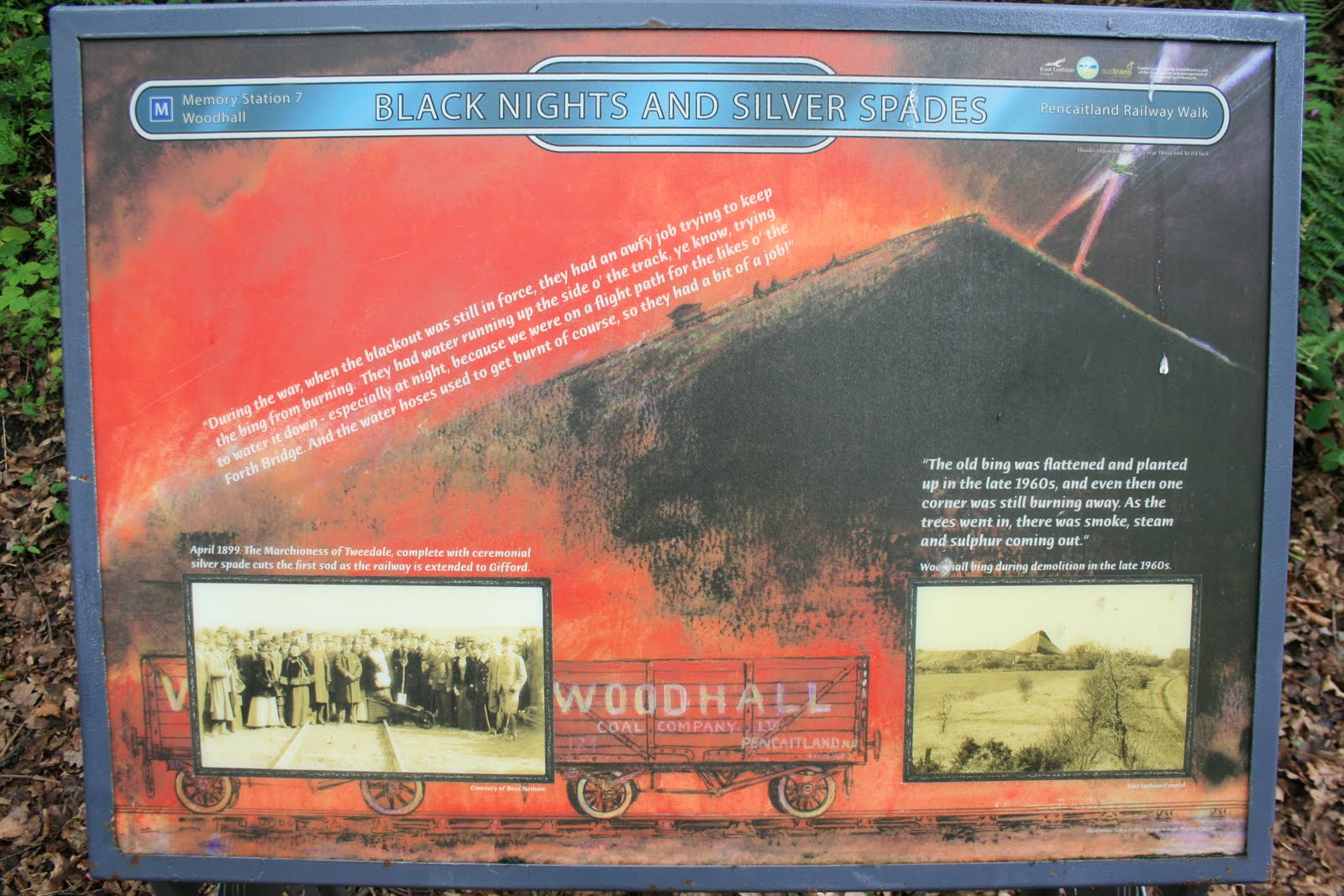
For those keen on cycling or walking,a short Sustrans path along the former Edinburgh to Gifford railway line at Pencaitland has informative noticeboards and 'gravestones' marking sites of former pit heads along the route.


Saturday, 2 July 2011

Writers and Reivers:A walk with author Alistair Moffat through Border History

This afternoon I spent in the company of the Border's author,Alistair Moffat.Well known for his previous work with the Edinburgh Festival Fringe in the 1970's he later became director of programmes with Scottish Television. A native of Kelso he has now returned to the Borders to live where in 2004 he founded the Border's Book Festival in Melrose. He has had success with several recent historical publications: The Borders (2005), The Reivers (2007) and The Scots A Genetic Journey (2011).
Alistair had kindly agreed to accompany us on a walk from Corehead farm into the Devil's Beef Tub - a large corrie formed in the last Ice Age and reputedly the former haunt of the Reivers coralled cattle,sheep and goats.
Stopping as we made our way along the numerous sheep paths,Alistair regaled us with stories of the turbulent life of the Border Reivers from his book The Reivers.


The final stop beside the sheep stell (a circular stone dyke pen) it was easy to imagine the description by Sir Walter Scott in his novel, Redgauntlet as “if four hills were laying their heads together, to shut out daylight from the dark hollow space between them. A dammed deep, black, blackguard-looking abyss of a hole it is”

Alistair ended with his observations of a typical Borderer.Perhaps typified by the former Scottish rugby player,Jim Telfer and the former English footballer,Jackie Charlton. Both holders of former Reiving surnames.
You can join Alistair Moffat in a more salubrious setting at the Edinburgh International Book Festival on Friday 26 August 3.30-4.30 at Scottish Power Studio where he will talk about Unravelling Scotland's DNA -the theme of his latest book.

Corehead in upper Annandale was bought by the Borders Forest Trust (BFT) in 2009 by public subscription and through traditional agricultural practices and ecological restoration techniques, is bringing the landscape into conservation management, creating native woodlands, wetlands, hay meadows and heather moorland habitats

Monday, 20 June 2011

Wednesday, 25 May 2011

Scottish Clan and Family DNA Projects - G

G

Galbraith- http://www.clangalbraith.org/
Gall,Gaul- http://www.worldfamilies.net/surnames/gaul
Gallie - http://www.worldfamilies.net/surnames/gallie
http://www.familytreedna.com/group-join.aspx?Group=Gallie
Galloway - www.worldfamilies.net/surnames/galloway/
Gardiner,Gardner - www.familytreedna.com/public/GardnerGarner/
Garland - worldfamilies.net/surnames/g/garland/
Garrat,Garrett - www.familytreedna.com/public/GarrettDNAproject/
Garrison,Garson - www.familytreedna.com/public/garrisonscompass/
Garvie -  freepages.genealogy.rootsweb.com/~dgarvey/

Gay - www.worldfamilies.net/surnames/g/gay/
Geer - worldfamilies.net/surnames/g/geer/
George - www.familytreedna.com/public/george/
Gerard,Gerrard - www.familytreedna.com/public/gerard
Gibb,Gibbs - www.wnconline.net/~hermes/gsdnap/

Gibson - www.worldfamilies.net/surnames/g/gibson/
Gifford - www.familytreedna.com/public/Gifford/default.aspx
Gilbert - www.janegilbert.org/gilbertdna/
Gilchrist - www.familytreedna.com/public/Gilchrist/
Giles - www.worldfamilies.net/surnames/giles/
Gill - www.rootsweb.com/~ctcsouth/GillDNA/index.html
Gillespie - www.familytreedna.com/public/GillespieDNAProject/
Gilmore - www.familytreedna.com/public/gilmorefamily/
Glass - www.worldfamilies.net/surnames/g/glass/
Glen,Glenn - www.familytreedna.com/public/glenn/
Glover - www.worldfamilies.net/surnames/glover

Gordon - www.familytreedna.com/public/gordondna/default.aspx
Gracie - www.familytreedna.com/public/Gracie/
Graham - www.familytreedna.com/public/Graham/
Granger,Grainger - worldfamilies.net/surnames/g/granger/
Grant - freepages.genealogy.rootsweb.com/~grantdna/index.html

Gray - www.familytreedna.com/public/GRAY%20or%20GREY%20Surname/
Green - www.familytreedna.com/public/Green/
Greer,Grier,Grierson - www.familytreedna.com/public/GREER/
Gregory - www.familytreedna.com/public/GREGORYDNAProject/
Gunn - worldfamilies.net/surnames/g/gunn/
Guthrie - www.familytreedna.com/public/guthrie/

Tuesday, 24 May 2011

Robinson Crusoe's Birthplace For Sale

The site of the birthplace of Alexander Selkirk upon whose story Daniel Defoe based his fictional character Robinson Crusoe is currently for sale.* Situated at 101 Main Street,Lower Largo,Fife the one bedroom ground floor flat is built upon the original house where Selkirk was born in 1676.
The early life of Selkirk or Selcraig is well documented in the kirk session records of Largo Parish. On 27 Aug 1695 he was charged with 'undecent carriage' in church but he 'did not comper having gone away to ye sea: this business is continued till his return'


Running off to sea on numerous occasions he ended up on the Cinque Ports a ship he felt unseaworthy.Asking to be put ashore his shipmates failed to join him and so for the next 4 years 4 months he lived alone on the island of Mas a Tierra in the Pacific.In 1966 it was officially renamed Robinson Crusoe Island. He was rescued and returned to Largo in 1717 but left again for London.Eventually he became a Lieutenant on the Royal Navy ship Weymouth and died of suspected fever 13 Dec 1721.He was buried at sea off the west coast of Africa.


Gravestone of Alex Selkirk's parents.Upper Largo Kirk. Surrounded with seashells


A fascinating account The Real Robinson Crusoe,written by Bruce Selcraig a descendant of Alex.Selkirk's brother appears in the Smithsonian magazine.
http://www.smithsonianmag.com/history-archaeology/crusoe.html?c=y&page=1
*Offers over £125,000

Saturday, 14 May 2011

Moffat's Royal Mail Martyrs

Many times I have driven south on the road from Edinburgh to Dumfries in all types of weather passing a large cairn at the watershed between the Tweed and Annan rivers. Here half a mile beyond the Devil's Beef Tub on 1 February 1831,two officers of the Royal Mail coach between Dumfries and Edinburgh perished in a snow storm. John Goodfellow the driver and James McGeorge,the guard had just changed their horses in Moffat before embarking on the steep pull out of the town. Already snowing heavily they became stuck so advised the male passengers to return to Moffat for a post chaise for the ladies.


Their strong sense of duty to deliver the mail prevailed,so they unharnessed the horses and plodded on into the drifting snow. They never made it. Their bodies were later found near a burn where the memorial cairn was erected in 1931. Their bodies were interred in Moffat kirkyard where two memorials were erected through public subscription.
So if speeding bye remember the efforts of Goodfellow and McGeorge
                                          

Wednesday, 4 May 2011

West Lothian History and Heritage Fair

This event is being held at Linlithgow Academy on Saturday 7 May at 10 am-4.30pm .Entry £2 children under 16 free. Range of stalls and guest speakers but talks must be prebooked,remaining
tickets available on the day.
Programme
10.00am: Stalls & displays open


10.00am - 12 noon: Family History Workshop, West Lothian Family History Society Free intro
ductory session


10.15am - 11.15am: professor John R Hume OBE, Chairman of the Royal Commission on the Ancient and Historical Monuments of Scotland: Churches of West Lothian.


11.30am - 12.30pm: Dr Fiona Watson, freelance historian, writer and broadcaster: Macbeth, a true story.


2.00pm - 3.00pm: Dr Lizanne Henderson, B.A., M.A. lecturer in History, University of Glasgow, Crichton Campus: Aspects of the Scottish Witch Hunt.


3.15pm - 4.15pm: Morrice McCrae MB, MSc, PHD, FRCPE Formerly Consultant Physician to the Royal Hospital for Sick Children, now College Historian, Royal College of Physicians of Edinburgh: West Lothian: A Medical Legacy.

Thursday, 28 April 2011

Creag an Tuirc- Clan MacLaren


This view from Creag an Tuirc is of Loch Voil in Balquhidder,  long associated with Rob Roy and the clan MacGregor, however the clan MacLaren were the original occupants. In 1558 under continuous pressure from the Campbells,the MacGregors moved south into Balquhidder where they massacred 18 MacLaren families and took their farms. There remained an uneasy relationship between the two clans for the next 200 years. The meeting place,slogan and motto of the MacLarens is called Creag an Tuirc- The Boar's Rock. This is situated behind Balquhidder kirk,a short steep climb up Kirkton glen.


The father of the present chief was recognised by the Lord Lyon as MacLaren of Achleskine and chief of the MacLarens. He purchased part of the old homelands including Creag an Tuirc and his son Donald MacLaren of MacLaren lives at Kirkton farm.Last year in the general election he stood as an independent candidate against the Prime Minister Gordon Brown.
The clan MacLaren hold an annual gathering at the Lochearnhead Highland Games due this year on 23 July.

Wednesday, 20 April 2011

John Muir and the Prestongrange Industrial Heritage Museum


Cornish Beam Engine
 Today is the anniversary of the Scottish born American 'Father of National Parks,' environmental conservationist John Muir. He was born in Dunbar on 21 April 1835 and to commemorate his connections with the area a long distance footpath was built from Dunbar to Musselburgh.Situated on route is a former industrial site I am sure he would have approved - Prestongrange Industrial Heritage Museum. Located on an area which can trace its origins back to the monks of Newbattle abbey and coal mining in the 12th century it has also been the focus of brick,glass, and pottery manufacturing.Following closure of the coal mine in 1962 and the brick works in 1975 it became Scotland's first industrial museum. A collection of mining and brick artifacts were put on display when it became obvious that a way of life and material culture were rapidly disappearing. On the site there are also an original Cornish Beam engine and Hoffman kiln.Since the 18th century several waves of immigrants from Venetian glass makers to Irish railway gangers settled in the area.There is a collection of named photographs and an excellent reference library of local research into the coal mining,brick and glass industry.
Children on site of current museum

The museum and East Lothian Local History Society are always keen to locate descendants of the original workers and record reminiscences which can be added to the museum's audio tour. This museum is well worth visiting and an added bonus it is free. If you’d like to be involved in this exciting project or would like more information please get in touch.

Contact Katherine Weldon, Assistant Museums Officer, Museums and Libraries HQ, Dunbar Road, Haddington, East Lothian, EH41 3PJ, 01620 828224, kweldon@eastlothian.gov.uk

I have heard Neil Oliver will be going to the USA and Yellowstone Park to make a BBC programme about John Muir.

Sunday, 20 February 2011

John Hunter- A Covenanting Martyr 1685

Last year I visited this memorial beside the Moffat-Edinburgh road overlooking the Devil's Beef Tub to John Hunter. He came from the parish of Tweedsmuir in Peebleshire and while visiting a sick friend in the farm of Corehead in Moffat he was surprised by dragoons of Col Douglas who was searching the area for field conventicles of outlawed Presbyterian Covenanters. Hunter tried to flee up the hillside opposite the memorial. Trying to take to the steep ground unsuitable for horses was to no avail. He was captured and executed on the spot,marked by a boulder known as the Martyr's Stone. His body was recovered and taken back to Tweedsmuir where it was interred in the local parish cemetery. The gravestone was erected in the 18th century and cared for by Robert Paterson "Old Mortality" in the book by Sir Walter Scott. The Hunter,Welsh,Fraser,Hope,Tweedie and Porteous families were long associated with this area. See http://www.ajbhope.net/tweedsmuir-and-the-covenanters/ for more local information.